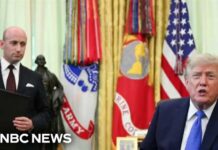

A top Trump-world voice blamed busy mothers for the Republican Party’s massive midterm losses, then admitted on live television that she herself never cast a ballot.
Quick Take
- Conservative podcaster Katie Miller, wife of senior Trump adviser Stephen Miller, said mothers were “too busy” to vote and that this hurt Republicans.
- Miller then admitted she did not vote in Virginia, saying she feared voting would reveal, or “dox,” her home address.
- Vice President JD Vance offered a different explanation, saying the Iran war, not turnout, drove Trump voters to switch to Democrats.
- President Trump acknowledged the war and rising gas prices played a role in the Republican defeat.
- Researchers say post-election parties often float dozens of competing excuses before settling on one accepted story.
A Podcaster’s Blame Game Draws Backlash
Katie Miller told CBS News after the midterm elections that mothers were partly to blame for the Republican Party’s steep losses. “You see that moms are too busy raising their children and taking care of them to get to the polls,” she said. Her comment pointed to low turnout among mothers, not simply their voting preferences, as a reason Republicans lost control of both chambers of Congress.
Miller is identified in news reports as a conservative podcaster married to Stephen Miller, a senior Trump administration official. Her comments carried extra weight because of that connection, tying her claim directly to the White House’s inner circle rather than treating it as an outside opinion. Several outlets quickly picked up the remark and began checking it against her own actions.
Her Own Vote Never Cast
When asked directly if she voted, Miller said, “I did not vote in Virginia.” She explained that casting a ballot there would “dox” her home address, raising privacy and security concerns. That reason has nothing to do with childcare, the explanation she gave for other mothers. The mismatch quickly became the headline, with outlets framing her blame of moms as hypocritical given her own absence from the polls.
Miller’s claim also does not match available polling. One Fox News voter survey found 59% of women with children backed Democratic House candidates, compared to 38% for Republicans. That suggests many mothers who did vote leaned Democratic, a pattern about vote choice, not just about staying home. Her statement never separated Republican mothers from Democratic ones or identified which races the theory was meant to explain.
Vance Points to the Iran War Instead
Vice President JD Vance gave a very different account of the losses. “The reason we lost is the war,” Vance said, pointing to the conflict with Iran rather than any voter turnout problem. He argued Republican voters actually showed up at the polls in similar numbers to 2024, but many switched their support to Democrats instead of staying home.
“Our voters did show up. But the main problem is not turnout,” Vance said, adding that people who backed Trump and Vance in 2024 voted Democratic in 2026. He listed the war, the cost of living, concerns that America was not being put first, and the U.S. relationship with Israel as the real reasons Republican-leaning voters turned away from the party.
Trump Admits the War Hurt Republicans
President Trump agreed that the Iran conflict played a role in the defeat. He acknowledged the war drove gasoline prices up in the short term and said that increase contributed to voter frustration, even as he continued to defend his decision to take military action. His comments lined up with Vance’s war-focused explanation rather than Miller’s turnout theory about mothers.
I'm very concerned that the current Republicans who weren't voted out of office in the midterm bloodbath and will be part of the 120th Congress after January 3, aren't going to be very supportive of President Trump, maybe even LESS so that the 119th Congress, because they want… https://t.co/i8TfrFyI7g
— Bud Meyers (@RealBudMeyers) November 8, 2026
The split between Miller’s and Vance’s explanations reflects a wider scramble inside conservative media and politics to explain the scale of the loss. Reports describe ongoing disagreement among Republicans over whether the war, the economy, candidate quality, or turnout patterns deserve the most blame, with no single accepted answer yet emerging from the party.
A Familiar Pattern After Election Losses
Political scientists say this kind of scramble is common. A study of coverage after the 1984 election found more than 80 different explanations circulating in the weeks right after the vote, with only about ten surviving as accepted narratives two months later. Parties facing defeat often produce competing stories before settling on one, especially when internal factions compete for influence over what comes next.
For voters on both sides already frustrated with Washington, the dueling excuses highlight a familiar complaint: leaders arguing about blame instead of addressing why millions of Americans feel let down by both parties. Whether the real cause was the war, the economy, or turnout, the losses were steep enough that Republicans are still sorting out what actually happened.
Sources:
themirror.com, huffpost.com, ibtimes.co.uk, pbs.org, edition.cnn.com, psmag.com
© libertyinsidernews.com 2026. All rights reserved.