
(LibertyInsiderNews.com) – For the first time in over two decades, a Republican has surged ahead in the New York governor’s race, upending the state’s political expectations and leaving both parties scrambling for answers.
Story Snapshot
- Elise Stefanik leads Kathy Hochul 43% to 42% in new poll, signaling historic GOP momentum in deep-blue New York.
- Poll highlights voter dissatisfaction with progressive policies, crime, and cost of living under Democratic leadership.
- Manhattan Institute’s methodology and conservative ties spark controversy over poll’s accuracy and bias.
- Both parties reassess strategies as the 2026 gubernatorial race suddenly grows fiercely competitive.
Historic Poll Ignites Political Shockwaves
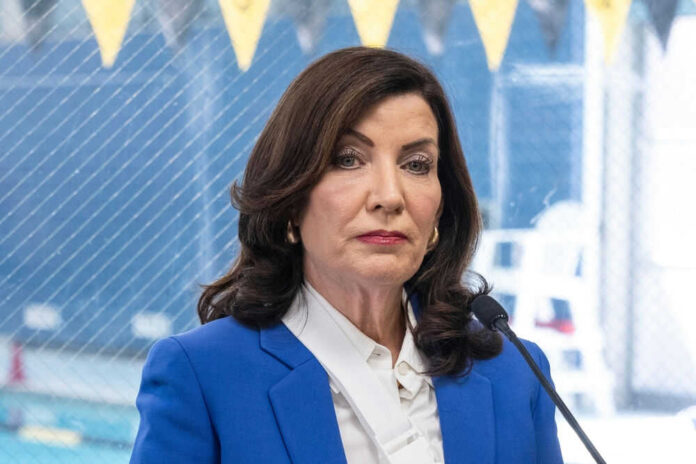
Elise Stefanik’s narrow lead over incumbent Governor Kathy Hochul, revealed by a Manhattan Institute poll, has stunned political observers across the state. The poll, conducted in late October 2025 among 300 registered voters statewide and 600 likely New York City voters, marks the first time since the early 2000s that a Republican candidate has polled ahead of a sitting Democratic governor in New York. This single-point edge may be numerically modest, but its symbolic weight is enormous in a state where Democrats have held a near-monopoly on power for years.
Stefanik’s advantage, extending to a six-point lead over Lieutenant Governor Antonio Delgado, signals deeper discontent beyond the governor’s office. These results have triggered a fevered response, setting off media speculation, campaign recalibrations, and urgent internal discussions within both parties. The story is not merely about numbers but what those numbers say about shifting political tides and the vulnerabilities of Democratic leadership.
Voter Frustration Fuels GOP Surge
Hochul’s administration has faced mounting criticism for policies on crime, bail reform, and economic management. New Yorkers have voiced growing frustration over rising costs of living, a sense of deteriorating public safety, and progressive policies that, for some, seem out of step with everyday realities. These issues have opened the door for Stefanik, whose campaign has capitalized on this dissatisfaction, positioning herself as a sharp alternative to the status quo. Her national profile as a Trump loyalist and her assertive style have energized the GOP base, even as her alignment with Trump risks alienating moderate voters.
The poll’s timing is critical. It comes as New York City grapples with its own contentious mayoral race and as statewide sentiments shift in unexpected ways. While Hochul’s team disputes the poll’s accuracy, citing the Manhattan Institute’s conservative orientation and past polling errors, the numbers nonetheless reflect a realignment in public opinion that could fundamentally reshape New York’s political landscape.
Methodology and Bias: Scrutiny Intensifies
The Manhattan Institute’s involvement in the poll has raised questions about methodology and impartiality. With known conservative ties, the think tank’s polling practices are under the microscope, especially as Hochul’s campaign points to previous inaccuracies and the potential influence of board members with Trump connections. The sample size, only 300 statewide voters, adds another layer of uncertainty, inviting skepticism about the reliability and representativeness of the results.
Expert commentators urge caution, highlighting that over a year remains until the 2026 election and that voter sentiment can shift dramatically in that time. Political scientists note that while the historic nature of Stefanik’s lead is undeniable, it is essential to corroborate these findings with additional polling and to monitor broader trends, especially turnout dynamics and the interplay of urban, suburban, and upstate interests.
Ripple Effects and Strategic Shifts
The shock poll has set off a cascade of strategic recalibrations across the political spectrum. Republican leaders and donors see an unprecedented opportunity to contest a governorship long considered out of reach, while Democrats scramble to shore up support and address internal divisions. Both parties are reassessing messaging, outreach, and endorsements, cognizant that the 2026 race could be the most competitive in a generation.
Economic and social implications loom large. A Republican victory could mean dramatic changes in tax, spending, and regulatory policies. Debates over crime, education, and social services will likely intensify, with urban, suburban, and rural communities experiencing different impacts. The result could ripple far beyond New York, influencing national party strategies and the broader narrative of political realignment.
Copyright 2025, libertyinsidernews.com