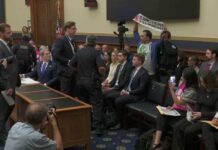

A House committee hearing branded activist groups “Trojan horses” for foreign propaganda, then had Capitol Police physically remove three protesters, including a co-founder of the peace group CodePink, right in the middle of the proceedings.
Quick Take
- House Foreign Affairs Committee held a hearing titled “Trojan Horses: Covert Foreign Malign Influence Operations in America.”
- CodePink co-founder Medea Benjamin and two others were removed during the hearing.
- Fox News reported a Singham-linked funding network sent $1.33 million to CodePink out of $278 million spread across left-leaning groups.
- CodePink flatly denies taking any foreign government money and calls the accusations false and defamatory.
- No court ruling, charging document, or federal enforcement action has confirmed CodePink is a foreign agent.
Hearing Turns Into a Spectacle
The House Foreign Affairs Committee’s South and Central Asia Subcommittee ran the hearing to examine how China, Cuba, and Iran try to shape American politics through nonprofit groups. Lawmakers named CodePink directly as one of the organizations they believe helps carry out these campaigns. During the session, security removed CodePink members from the room, turning a policy hearing into a viral confrontation caught on video.
Committee members used the word “Trojan horse” to describe how they think foreign money hides inside familiar-looking activist groups. That framing set the tone for the entire hearing, treating certain domestic advocacy organizations as vessels for outside government interests rather than as independent activists.
Money Trail Claims Take Center Stage
Fox News Digital reported that businessman Neville Roy Singham has pushed $278 million into a network of left-leaning groups, with CodePink receiving $1.33 million of that total. Separately, the House Committee on Natural Resources said in a 2023 letter that about a quarter of CodePink’s donations since 2017, more than $1.4 million, came from two groups tied to Singham. Senator Chuck Grassley later cited similar funding figures in letters to the Justice Department and Federal Bureau of Investigation (FBI), pointing to what he called foreign ties.
A State Department report sent to Congress went further, saying China “spreads propaganda through influence campaigns run by nonprofit organizations like Code Pink”. That kind of language from a federal agency adds weight to the committee’s claims, even though it does not amount to a legal finding.
CodePink Pushes Back Hard
CodePink rejects every part of the accusation. The group states plainly: “CODEPINK is in no way funded by China, nor any other foreign government or agency,” and adds that it has no contact with the Chinese Communist Party and is not legally required to register as a foreign agent. The group says its money comes from individual donors and American nonprofit foundations, not from any government overseas.
Medea Benjamin, Two Activists Escorted From House Foreign Influence Hearing
A House Foreign Affairs hearing on foreign influence turned into a protest scene Tuesday when CodePink co-founder Medea Benjamin and two fellow activists were escorted from the room by U.S. Capitol… pic.twitter.com/AhkBz1ThyQ
— CSB News USA (@csbnewsus) September 16, 2026
None of the material gathered so far includes a court judgment, a Justice Department charging document, or a formal enforcement action proving foreign control over CodePink’s activities. The strongest evidence made public traces donations from Singham-linked groups to CodePink, but tracing money is not the same as proving a foreign government directed how that money got spent.
Bigger Fight Over Where the Line Sits
This clash fits a much older pattern. The Foreign Agents Registration Act, first passed in 1938, was built to force transparency when someone acts on behalf of a foreign government. Legal scholars at Duke University describe the law as broad and unevenly enforced, which makes it a tool that can target real foreign agents or sweep in unpopular domestic activists depending on who is doing the enforcing.
That tension cuts both ways for ordinary Americans watching this story. Voters skeptical of unchecked government power worry that “foreign influence” labels could be stretched to silence dissent. Voters worried about hidden foreign money worry that vague denials let real problems slide. Bank records, donor ledgers, and a full hearing transcript could settle which concern is closer to the truth, but none of that has been made public yet.
Sources:
facebook.com, foxnews.com, wfmd.com, codepink.org, naturalresources.house.gov
© libertyinsidernews.com 2026. All rights reserved.