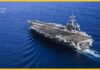

North Korea just put a heavily armed warship to sea under Kim Jong Un’s direct eye, raising fresh questions about who really controls peace and security in the Pacific.
Story Snapshot
- Kim Jong Un personally oversaw cruise missile tests from the new destroyer Choe Hyon, which North Korea says is part of a nuclear-armed navy.
- The 5,000-ton warship went through more than a year of trials and is now formally in service, with Kim calling it a “radical shift” in sea defense.
- State media claims the ship can fire nuclear-capable ballistic and cruise missiles, but there is still no independent proof of real nuclear integration.
- Kim is ordering more large destroyers and talks about “limitless expansion” of nuclear forces, adding pressure to an already unstable region.
Kim’s New Destroyer and Missile Tests
North Korean leader Kim Jong Un has been spending a lot of time on the deck of the new destroyer Choe Hyon, personally directing weapons tests at sea. State media says he watched sea-to-surface strategic cruise missiles fire from the ship during trials in early March 2026, and again oversaw missile launches from the vessel over a weekend in April. Photos and video pushed by Pyongyang show Kim touring the ship and treating it as his prized symbol of a more powerful navy.
Reports from the Associated Press and other outlets, based on North Korean state media, say Kim monitored the launch of strategic cruise missiles and anti-ship missiles from the 5,000-ton Choe Hyon. After the April tests, he repeated that his government is focused on the “limitless expansion” of nuclear forces and ordered new tasks to sharpen nuclear strike and fast-response abilities. These tests are framed not as routine training, but as steps toward a navy that can carry nuclear weapons far beyond North Korea’s coast.
What Makes the Choe Hyon Different
The Choe Hyon is described by North Korea and outside analysts as the country’s largest and most advanced surface warship, at about 5,000 tons. Naval reporting claims it carries a dense set of missile launchers, including dozens of vertical launch cells plus other launchers that could, in theory, handle many different missile types. Satellite images and trial reports show the ship sailing from Nampo on the west coast and going through a long series of tests before being placed into active service in June 2026.
State media says the destroyer can carry nuclear-capable ballistic and cruise missiles, along with anti-air and anti-ship weapons. That matches Kim’s broader push to put nuclear weapons on sea platforms, not only on land or submarines. At the commissioning ceremony, Kim said the navy’s nuclear armament program is “following its planned course unerringly” and claimed the ship proves the fleet has broken out of “stagnation” that lasted more than 70 years. For an isolated country under heavy sanctions, building and deploying such a ship is meant to show both strength abroad and success at home.
Claims, Doubts, and the Nuclear Question
Here is the key tension: North Korea loudly claims the Choe Hyon carries nuclear-capable missiles, but no independent technical data backs that up so far. Outside experts point out that Pyongyang has a long history of announcing big weapons breakthroughs that remain unverified, especially when it comes to nuclear payloads at sea. Some analysts also question the reported number of missile cells on the ship and highlight that the vessel even capsized during its launch in 2025 before being repaired.
Regional militaries, including the United States and South Korea, track these tests closely but have not publicly confirmed each launch from the Choe Hyon. Intelligence studies note that North Korea is clearly expanding its nuclear infrastructure, including new uranium enrichment activity, yet they stop short of proving that this specific destroyer now sails with live nuclear warheads. The gap between loud state claims and limited outside proof leaves regular people caught between fear of real danger and frustration with a global system that rarely gives clear, honest answers.
Why It Matters for Ordinary Americans
Kim is not just building one ship. He has called for two large surface warships of 5,000 tons or more every year for five years, and state media says third and fourth destroyers are already in planning or under construction. That means a small, poor, heavily sanctioned country is racing to put more missile-packed ships on the water while many Americans feel their own government cannot even fix roads, control the border, or keep prices stable. It feeds the sense that global elites focus on faraway power games instead of basic security and prosperity at home.
🇰🇵 "It's a Done Deal": Kim Jong Un Sets Two-Month Deadline for Commissioning Second Destroyer
On July 3, as part of the combat capability assessment program for the *Choe Hyon*-class destroyer *Kang Gon*, test launches of a strategic cruise missile were conducted from the… pic.twitter.com/9qhgMh4bo6
— dana (@dana916) July 5, 2026
For conservatives, this looks like one more reminder that decades of “managed” globalism and weak deterrence let hostile regimes grow stronger while Washington argued over pronouns and green energy mandates. For liberals, it underscores how military brinkmanship and endless rivalry keep draining resources from health care, schools, and fair wages. Both sides can see something troubling in a nuclear-armed dictatorship sailing new warships while our own leaders, of both parties, seem more focused on fundraising than on serious, transparent planning for war and peace.
Growing Risks in an Already Tense Region
North Korea’s destroyer does not sail in a vacuum. The Council on Foreign Relations and other trackers show the country firing a mix of tactical ballistic missiles, artillery rockets, and advanced cruise missiles in recent months, many aimed toward waters near South Korea. Kim has called South Korea the “most hostile state” and says his nuclear status is “irreversible,” which makes compromise harder and mistakes more dangerous. Each test gives allied militaries a reason to run new drills, and each drill gives Pyongyang a reason to claim it needs more nuclear weapons.
Defense reports warn that this back-and-forth can bring accidental clashes, misread signals, or cyber attacks that spiral out of control. For citizens watching from afar, it can feel like the same story repeating: leaders trade threats, weapons get more powerful, and ordinary families carry the risks without having any real say. The Choe Hyon’s missile tests are one more brick in that wall, showing how fast a small group of rulers can change the balance of power at sea while democracies struggle to hold their own leaders accountable.
Sources:
military.com, nknews.org, navalnews.com, en.wikipedia.org, youtube.com, news.usni.org, facebook.com, abcnews.com, pbs.org, instagram.com
© libertyinsidernews.com 2026. All rights reserved.